
Fox’s Geraldo Rivera wins contract dispute with former talent agency
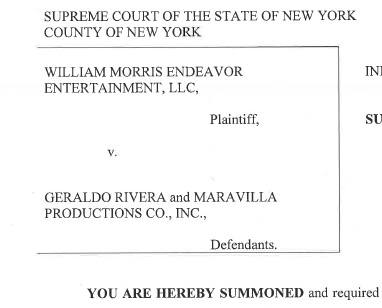
A New York City Supreme Court judge granted Geraldo Rivera’s Motion to Dismiss a complaint filed against him by William Morris Endeavor Entertainment, LLC, a national talent agency. According to the Complaint, which you can read here, Rivera stopped paying his ten percent (10%) commissions to William Morris in 2010. The agency sued for breach of contract, unjust enrichment and quantum meruit.
Rivera originally hired William Morris by letter agreement. You can read that here.
According to the pleadings, a series of renewals occurred, also by letter agreement, and were accompanied by boilerplate AFTRA agreements. You can read the most recent one of those here. Rivera claims he stopped paying because he believed his agreement was with a particular agent and that he did not need to pay the agency once that particular agent was no longer there.
The dispute centered around the existence of memorialized agreements and their express language.
Among the reasons for granting the dismissal is New York’s Statute of Frauds, which requires that agreements contemplating performance over a time period exceeding a year must be in writing. You may read the Order here. It explains the factual and procedural background of the case and is an interesting read.
According to the NY Daily News:
“This is a body blow to how Hollywood does business,” Rivera said. “It deals a blow to evil agents who wanted money for work they never did.”
Florida news org wins suit over duplication fees
The Florida news organization that sued a county clerk over excessive duplication fees has evidently prevailed.
Excerpts from the Watchdog City Press:
Brock had argued in court filings that as Clerk of Courts he is subject to Florida statute 28.24 and that he is allowed to charge up to $1 per page for records in his possession.
…
Judge Hardt wrote: “Under the facts in this case there is no conflict between Chapter 28 which governs the Clerk and Chapter 119 which governs access to public records. For documents stored in an electronic format, the Legislature has mandated that the authorized fee which may be charged by the Clerk for downloading the data on a computer disk may not exceed the cost of the disk. The cost of a computer disk does not exceed $1.00.
…
After Edwards published critical stories on Feb. 11, Brock charged $556, for 556 pages for electronic records on 2 CDs, saying as Clerk he is allowed to charge $1 per page for all records in his possession. Edwards filed the lawsuit challenging the fees on Feb. 25.
Read the entire article here.
Federal reporter’s shield law raises hopes, also criticism
Multiple media have noted Senator Chuck Schumer’s confidence that a federal shield law (the first of its kind), the “Free Flow of Information Act of 2013”, will see enactment this year.
You can read the text of the bill here.
From Politico:
“It’s very, very likely the Senate will pass a bill this year,” Schumer said. “Just about every Democrat is for the bill. … We have five Republicans on record being for it, three of them are co-sponsors.”
But there are at least three substantial challenges to the bill’s efficacy. The first, a broad national security exemption, has received the most attention; it also might be an unavoidable feature of any politically palatable media shield. The second is that the bill normalizes the process of subpoenaing reporter records and, worse, displaces accountability from within the Executive across the Judiciary, Congress, and a Fourth Estate that has enthusiastically endorsed judicial review of subpoenas. This cost, identified by Dave Pozen, suggests that reporters might be better off with no shield at all. The third challenge is the massive loophole the bill leaves for acquiring reporter records via third-party service providers.
Moderating your readers’ comments does not make your news organization “liable” for those comments
News organizations around the country have different approaches to handling comments on their web sites. One question that has long plagued news managers, and which still informs corporate policy-making, is whether moderating the comments posted on your site by third-parties increases your organization’s civil liability for the damage caused by those comments. The short answer is that it usually does not.
Techdirt posted a strongly worded reminder today about the broad immunity granted to web site owners and the fact that modifying comments does not remove that immunity. You can read the Techdirt piece here and link internally to their own excellent coverage and analysis of this issue in general.
Simply put, Section 230 of the Communications Decency Act creates broad immunity for a web publisher for the comments posted by third parties. The entire statue appears here, but here is the relevant language from subsection (c):
(c) Protection for “good samaritan” blocking and screening of offensive material
(1) Treatment of publisher or speaker
No provider or user of an interactive computer service shall be treated as the publisher or speaker of any information provided by another information content provider.
(2) Civil liability
No provider or user of an interactive computer service shall be held liable on account of–(A) any action voluntarily taken in good faith to restrict access to or availability of material that the provider or user considers to be obscene, lewd, lascivious, filthy, excessively violent, harassing, or otherwise objectionable, whether or not such material is constitutionally protected; or
(B) any action taken to enable or make available to information content providers or others the technical means to restrict access to material described in paragraph (1).
The bottom line is that the removal of offensive comments or the organization of third-party content on your site probably does not take your immunity away. Techdirt gets to the heart of it, but I thought I would add some case law to flesh out the reasoning and to highlight some parameters that are still being shaped:
First, here is the Fourth Circuit on the reason Section 230 was enacted:
Congress enacted § 230 to remove the disincentives to self regulation created by the Stratton Oakmont decision. Under that court’s holding, computer service providers who regulated the dissemination of offensive material on their services risked subjecting themselves to liability, because such regulation cast the service provider in the role of a publisher. Fearing that the specter of liability would therefore deter service providers from blocking and screening offensive material, Congress enacted § 230’s broad immunity “to remove disincentives for the development and utilization of blocking and filtering technologies that empower parents to restrict their children’s access to objectionable or inappropriate online material.” 47 U.S.C. § 230(b)(4). In line with this purpose, § 230 forbids the imposition of publisher liability on a service provider for the exercise of its editorial and self-regulatory functions.
Zeran v. Am. Online, Inc., 129 F.3d 327, 331 (4th Cir. 1997)
Now, some food for thought:
A District Court in Kentucky, recognizing that the Sixth Circuit has not yet weighed in on this, held that “a service provider is ‘responsible’ for the development of offensive content only if it in some way specifically encourages the development of what is offensive about the content.” Jones v. Dirty World Entm’t Recordings, LLC, 840 F. Supp. 2d 1008, 1010-11 (E.D. Ky. 2012).
This case is currently on appeal at the Sixth Circuit.
The reasoning of the District Court judge though is interesting. This Kentucky federal court identified a number of examples where the immunity ostensibly goes away. In one example, a web host lost its immunity because it “required subscribers to the site as prospective landlords or tenants to include information that was illegal under the Fair Housing Act.” In another example, “the operator of a web site that sold various personal data, including telephone records was violating certain federal confidentiality regulations.” The most interesting part of this opinion is the analysis of the case itself, which involved allegedly defamatory remarks about a female high school teacher posted on a web site called thedirty.com.
This Court holds that, under the principles of Roommates.com and Accusearch, the defendants here, through the activities of defendant Richie, “specifically encourage development of what is offensive about the content” of “the dirty.com” web site. First, the name of the site in and of itself encourages the posting only of “dirt,” that is material which is potentially defamatory or an invasion of the subject’s privacy. Richie’s activities as described in his deposition also require the conclusion that he “specifically develops what is offensive” about the content of the site. Richie acts as editor of the site and selects a small percentage of submissions to be posted. He adds a “tagline.” He reviews the postings but does not verify their accuracy. If someone objects to a posting, he decides if it should be removed. It is undisputed that Richie refused to remove the postings about plaintiff that are alleged to be defamatory or an invasion of privacy. Most significantly, Richie adds his own comments to many postings, including several of those concerning the plaintiff. In these comments, he refers to “the fans of the site” as “the Dirty Army.” He also adds his own opinions as to what he thinks of postings. Richie’s goal in establishing the site was to bring reality TV to the Internet. He wants everybody to log on to “the dirty.com” and check it out. In his opinion, “you can say whatever you want on the internet.” One of Richie’s comments posted concerning the plaintiff was “Why are all high school teachers freaks in the sack,” which a jury could certainly interpret as adopting the preceding allegedly defamatory comments concerning her alleged sexual activities. When asked about this comment, he stated: “[i]t was my opinion, you know, watching the news and seeing all these teachers sleeping with their students and, you know, just my opinion on all teachers just from, like, what I see in the media.” Richie also posted his own comment addressed directly to the plaintiff, stating in part: “If you know the truth, then why do you care? With all the media attention this is only going to get worse for you … You dug your own grave here, Sarah.” He further posted: “I think they all need to be kicked off [the Bengals’ cheerleading squad] and the Cincinnati Bengals should start over. Note to self. Never try to battle the Dirty Army. Nik.” And, perhaps most significantly: “I love how the Dirty Army has war mentality. Why go after one ugly cheerleader when you can go after all the brown baggers.”
This Court holds by reason of the very name of the site, the manner in which it is managed, and the personal comments of defendant Richie, the defendants have specifically encouraged development of what is offensive about the content of the site. One could hardly be more encouraging of the posting of such content than by saying to one’s fans (known not coincidentally as “the Dirty Army”): “I love how the Dirty Army has war mentality.”
Jones v. Dirty World Entm’t Recordings, LLC, 840 F. Supp. 2d 1008, 1012-13 (E.D. Ky. 2012)
Remember, this case is on appeal and a number of stakeholders have filed briefs to the Court. It is being closely watched.
What is the takeaway if you manage a news site? The general rule still controls: you are probably safe from liability even if you manage or modify the comments posted by your users, readers or viewers. This case presents a warning though, that at least one court has tried to remove that immunity when the web site “in some way specifically encourages the development of what is offensive about the content.”

Online commenters as sources? Maybe so… if done right
A recent New York Times blog post (article) discusses the valuable reporting contributions made by online commenters and how these “contributors” have become critical “sources” to modern reporting. The NYT piece is excellent and is linked here. As it happens, this classification of “commenters” as “sources” is of particular interest to me; in fact, there is an unpublished law review note on this very topic at the bottom of a drawer somewhere in my house. Sources, of course, have “legal” status under many state shield laws.
In other words, the term “source” is not just a colloquialism. It is a legal term of art. A journalist, in many states, is “privileged” to protect the identity of his “source.”
But why should such a privilege exist when the journalist writing the story (or reporting it for TV or radio) does not actually know the identity of this “source?”
Increasingly, around the country, lawyers are arguing that online commenters are sources and that their media clients should not be compelled to disclose their identities (I.P. addresses, email addresses, etc.).
Here are a couple of [hopefully] illustrative examples (describing real cases):
1. During the widely-reported criminal trials of two men charged in the shooting death of a Tennessee state trooper in 2007, defense attorneys sought to identify a series of anonymous commenters who had been posting on the web site of a local newspaper. The paper had been reporting on the proceedings and enabling its readers to opine just below the online version of its report. The defense, seeking a change of venue out of “concern” that some of these unnamed commenters might end up on their jury, sought to subpoena the newspaper to compel disclosure of the users’ identities. The newspaper’s lawyers successfully quashed the subpoena by arguing that these anonymous posters were “sources” and that the newspaper was privileged from disclosing their identities.
2. In Montana, an individual sued a newspaper seeking the identifying information about three anonymous commenters who that individual claims defamed him in a series of online comments. These allegedly snarky comments were posted by the unknown commenters below the article and after it was published. Here, the newspaper’s lawyers again defeated a subpoena for this information by arguing that these unknown commenters were “sources” as contemplated by Montana’s shield statute.
3. A Kentucky paper reported a story about a 20-year old university student who was reportedly evicted from an area shopping mall because her dress was too short. Beneath the article on the newspaper’s web site, an anonymous commenter alleged that the student had, on a prior occasion, intentionally exposed herself to a woman and two children. The student filed a “John Doe” suit and subpoenaed the newspaper to reveal identifying information about the anonymous commenter because the student had allegedly been damaged by this anonymous remark. Again, the media lawyer argued (among other things) that the commenters were “sources” under the Kentucky shield statute and that the newspaper should not have to reveal the identifying information.
Of those states with a reporter’s shield or a journalist’s privilege, many have statutes using different language; they are not all created equally. In many of these statutes, the definition that is most hotly debated is that of the “journalist”, i.e., is a blogger a journalist, etc.? Very few statutes define “source” and, as a result, courts with limited knowledge of the journalistic process, do not know what to do with the argument that online commenters are statutory sources.
Here’s another twist: There is a federal statute that protects web publishers from liability for the content posted by third parties on their web sites. I have a “primer” on that elsewhere on this site.
So imagine this: Your hometown paper writes an article about a recent charity drive you organized. The story is all positive. In the comments however, user “hater12834” posts a series of false remarks about you, alleging infidelity and drug abuse. Imagine that you are damaged in a measurable way by these remarks (your wife files for divorce, you lose your job, etc.). How can you be made whole? You cannot sue the newspaper, because of that federal statute I mentioned; the newspaper is not liable for the comments published on its site by third-parties. You do not know who “hater1234” is. The increasingly common strategy is to sue “John Doe” and then issue a subpoena to the newspaper for any identifying information regarding user “hater1286.” Then, you would replace John Doe with the true identity of the unknown defamer. Whoa! “Stop right there,” protests the newspaper. User “hater1234” is a “source” and under this state’s shield law, the newspaper argues, we do not have to divulge or unmask the identity of our sources!
Now what? In a number of cases, the damaged plaintiff is just out of luck because courts have, increasingly in recent years, allowed media organizations to point to online commenters and call them sources, when the journalist writing or reporting the story does not actually know who “hater1234” really is, never made a deal to protect his identity and did not actually use the comments as part of his reporting.
I should mention that in my example #3 above, the reporter who wrote the original story actually used the allegedly defamatory comments as the basis for a follow-up report. The lawyer in that case made that point in his “motion to quash” the subpoena and, in my opinion, that does tend to strengthen the argument that the online commenter provided “source” material for some journalism.
All that said, the number of cases that I have identified where this issue arises are primarily state court disputes and the law is generally unsettled in this area. Most reporter shield statutes do not define “source” and, unfortunately, I think this often results in abuse and the misapplication of the various state shield laws.
The NYT piece is titled, “For Some, Reader Contributions Become a New Reporting Tool.” It is a great piece about how some reporters are actually using online comments as part of their reportage. For what it’s worth, I think this kind of reporting reflects the upside in allowing and inviting online commentary. In my opinion, these NYT examples typify source-driven reporting. The headline though (“For Some”) implicitly acknowledges the downside, that there are others who are not using reader contributions as part of their reporting. Should these reporters and news organizations still be able to benefit from these shield laws?
Misconceptions: Why “right-to-work” may not apply to you
Having worked at three different television stations (none of which was unionized), I frequently heard how non-compete provisions (restrictive covenants) should not be enforceable in specific instances, because “this is a right-to-work state.” I still hear the expression from media-employed friends who perceive themselves to be aggrieved by their employers; they lean on their state’s “right to work” statute as a source of perceived bargaining strength. Employees in myriad industries believe that these statutes protect them from being kept out of the market by their employers after separation. In fact, this phrase is widely and woefully misused by many, particularly those in the media.
The phrase “right-to-work” is linked to labor laws that have changed, by state, as the specter of the “closed” union shop has faded. More plainly put, it is a union concept. If you do not work for a company that has union agreements, “right-to-work” does nothing for you.
For those interested in the meaning of the phrase, and for the many print journalists who are somewhat more commonly unionized, there was a time (pre-1947) when employers and unions were allowed to require union membership as a condition of employment. When employers established these requirements, they were called “closed” shops. The Taft Hartley Act did away with the closed shop in 1947. The Act freed the states however, to permit less restrictive versions of these shops, like the agency shop, where employees have to pay union dues even when they do not join the union, simply as a condition of employment.
Generally speaking, a right-to-work law allows employees to work for a company without having to have anything to do with its affiliated unions. More than two dozen states have right-to-work laws, including Tennessee, Mississippi and Arkansas. By way of example, here are a few of Tennessee’s right-to-work statutes. Tennessee makes it a Class A misdemeanor to violate these statutes.
§ 50-1-201. Denial of employment because of affiliation or nonaffiliation with labor union.
It is unlawful for any person, firm, corporation or association of any kind to deny or attempt to deny employment to any person by reason of such person’s membership in, affiliation with, resignation from, or refusal to join or affiliate with any labor union or employee organization of any kind. (Enacted 1947.)
§ 50-1-202. Contracting for exclusion from employment because of affiliation or nonaffiliation with labor union.
It is unlawful for any person, firm, corporation or association of any kind to enter into any contract, combination or agreement, written or oral, providing for exclusion from employment of any person because of membership in, affiliation with, resignation from, or refusal to join or affiliate with any labor union or employee organization of any kind. (Enacted 1947.)
§ 50-1-203. Exclusion from employment for payment of or failure to pay union dues.
It is unlawful for any person, firm, corporation or association of any kind to exclude from employment any person by reason of such person’s payment of or failure to pay dues, fees, assessments, or other charges to any labor union or employee organization of any kind. (Enacted 1947.)
In other words, in Tennessee, it is unlawful for an employer to not employ you because you are not affiliated with a union. They also cannot require you to pay union fees as a condition of employment (agency shop).

FCC proposal may herald end of JSAs as we know them
According to at least one outlet, the current FCC Chairman is going to propose a ban on Joint Service Agreements (“JSA”) and Shared Service Agreements (“SSA”), unless they serve a public interest. Current JSA and SSA agreements will be given a two-year sunset, under the proposal.
TVNEWSCHECK has the full story here:
The FCC order, assuming it’s approved March 31, will adopt “a rebuttable presumption that the costs of joint negotiation by non-Top 4 station combinations in the same market outweigh the benefits, and that joint negotiation among these combinations constitutes a failure to negotiate in good faith,” the FCC said in a background paper.
Court punts Yelp suit that claimed reviewers should be paid wages
On October 22, 2013, four regular reviewers on Yelp, Inc. (“Yelp”) sued Yelp in California District Court on behalf of a putative class, claiming that “every day millions of people use online reviews” and that the “hordes” of posters who contribute reviews to Yelp are being unfairly denied wages in violation of the Fair Labor Standards Act. Yelp makes most of its money through advertising sales, brand advertising and affiliate revenue. The content though is largely user-generated.
You can read the Complaint here. The plaintiffs also allege quantum meruit and unjust enrichment. It is an interesting claim and might have been interesting litigation.
Unfortunately, the case is over. As LegalNewsLine notes, Yelp filed a Motion to Dismiss. As to the FLSA claims, Yelp argued that it was not an “employer” of the “reviewers” because it did not have the power to hire and fire, lacked supervision and control over contributors, never determined pay rates, and never maintained employment records. The Plaintiffs, as it turns out, did not even put up a fight.
The District Court dismissed the case, not necessarily because Yelp made a winning argument, but because Plaintiffs filed no response during the time provided by the rules.
Black Owned Broadcasters pitch alternative SSA plan to FCC
The National Association of Black Owned Broadcasters (“NABOB”) has evidently pitched an alternative to the heavily anticipated crackdown on Joint Service Agreements (“JSA”) and Shared Service Agreements (“SSA”). You can read the ex parte disclosure by NABOB about the proposal here. According to the disclosure, NABOB Executive Director James Winston said some of the following to certain FCC Commissioners last week:
On February 26, 2014, the undersigned Executive Director and General Counsel of the National Association of Black Owned Broadcasters, Inc. (“NABOB”) met with Commissioner Mignon Clyburn and Adonis Hoffman, Chief of Staff to Commissioner Clyburn. In the meeting, I explained NABOB’s view that the continuing decline in minority broadcast ownership needs to be addressed in the Commission’s Quadrennial Review. I pointed out that less than ten years ago there were 21 full power commercial television stations licensed to African American controlledcompanies in the United States, and today there are only three. Moreover, of those three stations, two were just recently acquired and are being operated pursuant to Joint Sales Agreements (“JSA”) and Shared Services Agreements (“SSA”). Therefore, there is only one full power commercial television completely operated by an African American owned licensee.
The fact that there are so few African American owned television stations is a sad commentary on the state of diversity in the broadcast industry and calls Ms. Marlene H. Dortch February 27, 2014 for action on the part of the Commission to improve this abysmal ownership situation. I pointed out that the situation has caused NABOB to reconsider its previous position on JSAs and SSAs. I explained that NABOB has always opposed JSAs and SSAs, because they appeared to be mere gimmicks for group licensees to avoid the intent of the local ownership rules. However, NABOB and the Commission are faced with an unfortunate fact. Two of the three full power television stations licensed to African Americans are being operated under JSA and SSA agreements. In addition, given the precipitous fall-off of African American television ownership in the past few years, and the accelerating pace of consolidation that has roiled the television industry in recentmonths, there is no reason to be optimistic that the number of African American owned television stations is going to appreciably increase in the near future without some serious rethinking of the Commission’s policies.
. . .
To this end, I suggested that the Commission look at JSAs and SSAs on a case-by-case basis to see if they have the potential to promote diversity of ownership or other important Commission policies. If so, the Commission could place conditions on such JSAs and SSAs such that these agreements would be structured to enable the licensee of the station to eventually operate the station without the need for a JSA or SSA. In other words, the JSA or SSA would have clear steps in place that turned over full operation of the station to the licensee over time. For example, the JSA or SSA might be structured such that at predetermined periods, perhaps annually, the licensee and the JSA or SSA operator would file a progress report with the Commission reporting on the operational changes that have occurred in the reporting period that have turned over specific responsibilities to the licensee, and the licensee would identify the personnel and other enhancements it has made to the station to take over these responsibilities.
In this arrangement the JSA or SSA operator would be required to turn over full control to the licensee in a set period, perhaps five years. The annual reporting to the Commission should demonstrate that that licensee was making progress toward taking control. If the annual reporting failed to demonstrate that the licensee was making progress toward operating the station, the Commission could order an early termination of the JSA or SSA. In any event, whether the licensee had fully obtained the ability to operate the station over the five year period, the JSA or SSA would terminate at the end of that period.
TVNEWSCHECK first reported this and you can read their story, which includes comment from the National Association of Broadcasters (“NAB”), linked here.
NAB spokesman Dennis Wharton said of the proposal: “”NAB has documented numerous examples to the FCC of JSAs that benefit the public interest, improve local news, and provide badly needed competition to pay TV giants. NABOB deserves credit for coming up with another creative idea that could enhance TV ownership diversity in broadcasting. We think this idea merits serious consideration.”
Florida news org sues court clerk over copying fees
A reporter in Naples, Florida filed a suit over arguably excessive and “retaliatory” duplication fees that, she claims, vastly exceed the reasonable rate requirement codified in Florida statute. The Clerk tried to charge $1.00 per page. You can read the Complaint here.
This is from the Watchdog City blog:
Florida’s Government in the Sunshine Manual, on pages 167 and 168, specifically states that a Clerk of Courts cannot charge $1 a page for non-court and non-official records. The Sunshine Manual further references two Attorney General Opinions that prohibit this fee. The attorney general opinions are AGO 85-80 and AGO 94-60.
The Florida public records law, F.S. 119, sets forth copying charges for paper county documents at 15 cents a page, but it’s questionable whether Brock has the authority to impose even 15 cents per page for the electronic records sought by Naples City Desk.
You can read their entire article here. RTDNA has weighed in too, expressing its support in a letter to the clerk.
The Tennessee Public Records Act similarly maintains a “schedule of reasonable charges”, codified at Tenn. Code Ann. §8-4-604(8)(1), and described here in this article from the Comptroller’s office. In Tennessee, it’s 15 cents for black and white and 50 cents for color. Interestingly, public agencies may also charge a requesting party the responding individual’s hourly wage as a labor cost, to cover the labor involved in locating and duplicating the records.